
Introduction
When choosing vinyl flooring for commercial or distribution projects, importers often face a key decision: SPC or LVT?
While both are widely used, their structures, performance, and supply considerations are significantly different. This guide explains the practical differences importers need to know before placing orders.
1. Structural Differences
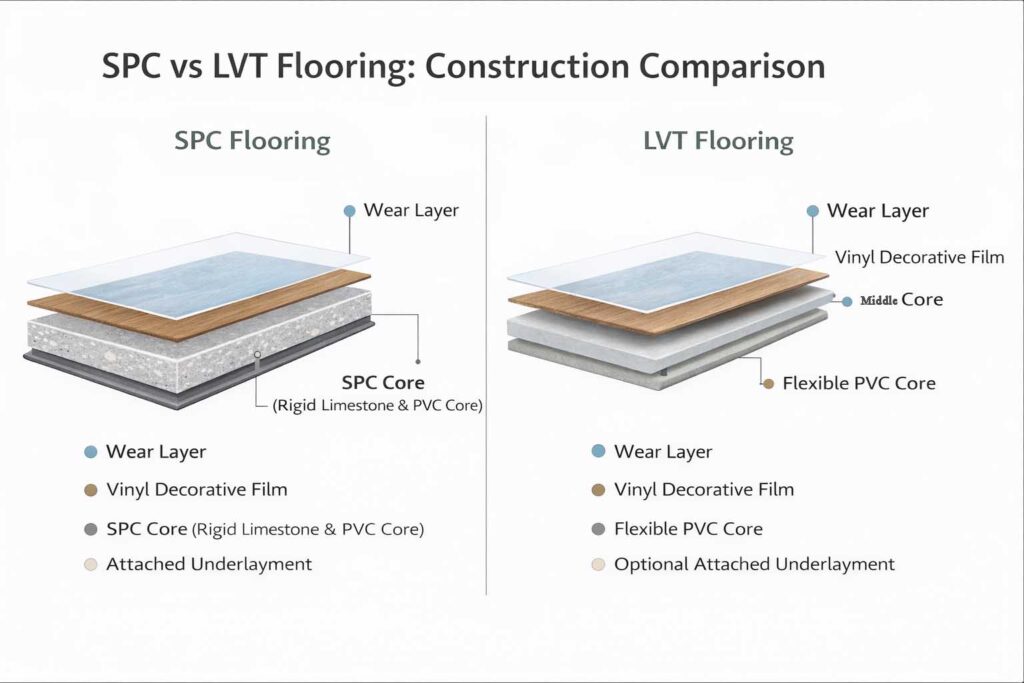
- LVT (Luxury Vinyl Tile) is flexible, multi-layer vinyl flooring, typically glued down.
- SPC (Stone Plastic Composite) features a rigid core made of limestone and PVC, offering higher dimensional stability.
👉 For importers, this structural difference directly affects transport risk, installation method, and after-sales issues.
2. Performance Comparison for Commercial Use
| Aspect | LVT | SPC |
|---|---|---|
| Dimensional stability | Medium | High |
| Temperature tolerance | Sensitive | Excellent |
| Installation | Glue-down | Click system |
| Subfloor tolerance | High requirement | More forgiving |
SPC is increasingly preferred for commercial and project-based orders due to reduced installation complaints.
3. Cost & Supply Chain Considerations
- LVT usually has lower material cost but higher installation cost.
- SPC may have slightly higher factory cost but lower total project risk.
For importers managing multiple projects, SPC offers more predictable outcomes.
4. When Importers Should Choose Each
- Choose LVT for renovation projects requiring thin profiles.
- Choose SPC for hotels, retail chains, offices, and export markets with unstable climates.
Conclusion
SPC and LVT are not competitors — they are tools for different scenarios.
Experienced importers often carry both, positioning SPC as a project-safe option and LVT as a flexible solution.
If you’re evaluating SPC for commercial projects, understanding MOQ and lead time expectations is essential before making a decision.
For buyers concerned about long-term performance, we also explain how quality control standards affect locking stability and dimensional performance.